Showing posts with label abbey road. Show all posts

Saturday, October 29, 2011

Album Summary: Abbey Road

Abbey Road, with its many magnificent medleys, has been an interesting and bittersweet journey. It's technically the last album by The Beatles (as The Beatles, together) and its eclectic yet cohesive track listing lulls the audience into a false sense of security. 

At this point in time, the Beatles were putting on a show for the world, meanwhile knowing it was virtually over for them. There was the odd hope here or there that the group could be salvaged--and their business dealings reflected that delusion, scheduling them for more releases and recording sessions. However, deep down everyone in the know knew that it was over. 

Abbey Road was born in that uncertain atmosphere, starting with the biographical unity of "Come Together" and charming the listener with some of the best Harrison works of his career ("Something" and "Here Comes the Sun") and drawing the audience deeply into the music with an entrancing 8-song medley. This album also contains what may be my personal favorite: "Golden Slumbers / Carry That Weight", which I can listen to over and over without tiring of the lyrics or the tune.

In short, Abbey Road was a fitting send-off for the greatest band of the age. (This may be confusing, since we're about to start the next (and final) Beatles album, Let It Be, but we're about to clear that up. :) )

Her Majesty

Sorry for the skipped song... very busy and exhausting day yesterday. Here it is!
"Her Majesty" is a quick little song that was added onto the end of Abbey Road due to Paul's fondness for it. Since it wasn't included in the original track listing, it's considered one of the first examples of a hidden track in rock music--a trick that everyone does nowadays. 

As we know already, it was supposed to be placed between "Mean Mr. Mustard" and "Polythene Pam", which is why the notes at the beginning and end correspond with the end and beginning notes of those two songs (respectively). "Her Majesty" is the shortest Beatles song at 23 seconds, and it's one of the three Beatles songs that reference, but not name, Queen Elizabeth II (the other two are "Penny Lane" and "Mean Mr. Mustard").

I think this song is pretty cute; I think it's probably required for any British artist to mention the queen at least once, and this might be the best one of them all. :P

That's it for "Her Majesty", now for the album summary!


~~~~~~~~~~~~~~~
Heard It Tally: 47
Songs Completed: 188

Thursday, October 27, 2011

Golden Slumbers / Carry That Weight / The End

Today we've reached the titular song of this blog, and even better--it's a triple song day! "Golden Slumbers", "Carry That Weight", and "The End" technically count as three songs (they're listed separately on the album), but the first two were recorded as a single song and, much like Chris Farley and David Spade, are better together. Also, "Carry That Weight" segues so effortlessly into "The End", a couplet, that it would be a shame to leave it out.

Although Lennon was absent during the first recording session due to his car accident, he was present for subsequent sessions. This medley features all four Beatles' voices on the tracks--a true rarity at this point and achieved through overdubbing--as well as individual solos for each person and their instrument/voice. "Carry That Weight" reprises the riff from "You Never Give Me Your Money", but instead of talking about money, it talks about pillows and invitations. 

The lyrics of "Carry That Weight" clearly refer to the Beatles themselves; Wikipedia gives us some slightly differing angles:
Music critic Ian MacDonald interpreted the lyric as an acknowledgment by the group that nothing they would do as individual artists would equal what they had achieved together, and they would always carry the weight of their Beatle past. McCartney said the song was about the Beatles' business difficulties and the atmosphere at Apple at the time. In the film Imagine: John Lennon, Lennon says that McCartney was "singing about all of us."
Personally, this might be my favorite Beatles song. The lyrics are astounding and Paul's voice is incredible, particularly in the beginning when he belts out "Golden slumbers fill your eyes / smiles awake you when you rise" (I still can't decide if it's "awake" or "await"). There's really nothing about this medley that I don't love--from the amazing crescendos that blow my mind every time, to the killer guitar solo near the end that precedes that thought-provoking couplet written by McCartney.

Although this medley was intended to close Abbey Road, "Her Majesty was tacked onto the end; McCartney enjoyed it there, so there it remained. We'll listen to that one tomorrow, and that'll be curtains for the album. See you then.


~~~~~~~~~~~~~~~
Heard It Tally: 45 - 46 - 47
Songs Completed: 185 -186 - 187

Wednesday, October 26, 2011

She Came in Through the Bathroom Window

"She Came in Through the Bathroom Window" was written by Paul McCartney. He was inspired by the Apple Scruffs, a term coined by George Harrison for the "dedicated fans who hung around outside the Abbey Road studio and the homes of the Beatles". 

One of these fans, generally girls, was Jessica Samuels, who gave her account of the time she and a few others broke into McCartney's home at St John's Wood. McCartney wasn't home at the time, so they propped a ladder up to the bathroom window and Samuels climbed in and let the others in by the front door. They ended up stealing several photographs, but other than that, the break-in seems to have been mostly good-natured. 

Of course, this could've been a made-up story; Mike Pinder, the former keyboard player of BirminghamR&B band The Moody Blues, claims the incident actually happened to him and that when he related the story to Paul McCartney, Paul proceeded to strum a tune on his guitar and sing, "She came in through the bathroom window". Wherever the inspiration for the song truly lies, chances are a groupie really did sneak into a musician's home through a bathroom window. :P

I really enjoy this song. The melody is catchy, and the lyrics are interesting and amusing, if somewhat nonsensical at times. Although this song wasn't featured in the film Across the Universe, it was referenced when the character Prudence introduces herself to the other characters by sneaking into their flat. When Sadie asks, "Where'd she come from?", Jude replies, "She came in through the bathroom window."

That's all for today! See you tomorrow. :)


~~~~~~~~~~~~~~~
Heard It Tally: 44
Songs Completed: 184

Tuesday, October 25, 2011

Polythene Pam

Today we meet "Polythene Pam", which continues the medley where "Mean Mr. Mustard" left off; both were written at the same time while Lennon and the others were in India. 

Wikipedia gives us a quote from John about the song as well as some interesting tidbits:
In 1980, John Lennon said about "Polythene Pam": "That was me, remembering a little event with a woman in Jersey, and a man who was England's answer to Allen Ginsberg...I met him when we were on tour and he took me back to his apartment and I had a girl and he had one he wanted me to meet. He said she dressed up in polythene, which she did. She didn't wear jack boots and kilts, I just sort of elaborated. Perverted sex in a polythene bag. Just looking for something to write about." The song is sung in a very strong Liverpudlian "Scouse" accent.
The lines "She's so good-looking but she looks like a man / Well you should see her in drag dressed in her polythene bag" really remind me of "Lola" by The Kinks. Overall a fun song. :)

That's all for today... see you tomorrow.


~~~~~~~~~~~~~~~
Heard It Tally: 43
Songs Completed: 183

Monday, October 24, 2011

Mean Mr. Mustard

The notorious "Mean Mr. Mustard" was created by John Lennon while he was in India,
...inspired by a newspaper story about a miser who concealed his cash wherever he could in order to prevent people from forcing him to spend it. On reflection, he did not think highly of the composition, describing it in Anthology as 'a bit of crap I wrote in India.'
Mr. Mustard's sister was originally named "Shirley", but she was renamed "Pam" so that the song could segue into tomorrow's song, "Polythene Pam". Also, "Mean Mr. Mustard" was supposed to precede "Her Majesty" before the latter was moved to the end of the album, which is why Mustard ends so abruptly and doesn't seem to flow very smoothly into "Polythene Pam". 

As a standalone song, there's not that much to talk about other than the lyrics; however, as part of the ongoing medley, it's a perfectly weird and suitable addition to the mix. :P

That's all for today! See you tomorrow. :)


~~~~~~~~~~~~~~~
Heard It Tally: 43
Songs Completed: 182

Sunday, October 23, 2011

Sun King

Today we meet the "Sun King". It was originally called "Here Comes the Sun King" but was changed to avoid confusion with George Harrison's song "Here Comes the Sun". "Sun King" was written mostly by John Lennon and is the second part of the B-side medley that begins with "You Never Give Me Your Money". 

Starting with the swamp noises that end "You Never Give Me Your Money", the song features another three-part harmony from Lennon, McCartney and Harrison (similar to "Because") as well as some nonsense "Romance" language words in the last three lines. According to Wikipedia, Lennon talked about those lyrics:
We just started joking, you know, singing 'cuando para mucho.' So we just made up... Paul knew a few Spanish words from school, you know. So we just strung any Spanish words that sounded vaguely like something. And of course we got 'chicka ferdy' in. That's a Liverpool expression. Just like sort – it doesn't mean anything to me but (childish taunting) 'na-na, na-na-na!'
That's all for today! See you tomorrow. :)


~~~~~~~~~~~~~~~
Heard It Tally: 43
Songs Completed: 181

Saturday, October 22, 2011

You Never Give Me Your Money

Paul McCartney's somewhat passive aggressive message to John Lennon is today's song. "You Never Give Me Your Money" was written during a turbulent time for the boys--their ongoing financial battles (which I'm currently reading about in You Never Give Me Your Money by Peter Doggett--fascinating read. I'd definitely recommend it) only added fuel to their arguments. 

There's no one whose opinion or esteem Paul valued more than John's, and John could be generous with his scorn when feeling petty, so the fights between them were often particularly vicious and downright mean-spirited. McCartney was mostly on his own side against the other three when it came to negotiating various contracts and, at one point, changed his phone number without telling any of the others. The song's opening verses can be interpreted quite literally in that respect.

The last part of the song seems to betray the emotion and relief that virtually everyone felt when it became apparent that "The Beatles" were no more. John was the first to declare his defection from the group (although George and Ringo had both left for short periods of time in the past), but it would ultimately be Paul's public abandonment that would spell the official end.

Work on Abbey Road overlapped the breakup; even after it became impossible to get all four Beatles in a room together, they were still creating songs and (trying to keep) working together--possibly mostly to fulfill the terms of their recording contracts. This song is a sad mile marker for The Beatles; the lyrics send a clear message in hindsight, yet it was one that no one--not audiences, critics, or even at times the Beatles themselves--would fully comprehend for a long time.

That's all for today. See you tomorrow. 


~~~~~~~~~~~~~~~
Heard It Tally: 43
Songs Completed: 180

Friday, October 21, 2011

Because

Today's excellent example of Beatles harmonizing, "Because", was written by Lennon. John, Paul and George harmonized and then their voices were triple-tracked, creating nine voices total. The song features an electric harpsichord played by George Martin, and a Moog synthesizer--The Beatles were one of the first groups (along with The Rolling Stones and The Doors, among others) to experiment with one. 

John addressed the song's similarity to a certain classical masterpiece:
According to Lennon, the song's close musical resemblance to Ludwig van Beethoven's "Moonlight Sonata" was no coincidence: "Yoko was playing Beethoven's 'Moonlight Sonata' on the piano ... I said, 'Can you play those chords backwards?', and wrote 'Because' around them. The lyrics speak for themselves ... No imagery, no obscure references."
As Lennon says, the lyrics are simple and straightforward. It sends a basic message--that love is everything. As controversial, argumentative, and downright belligerent as the Beatles were getting at this time, this song is a mark of their united creative genius. Obviously, Ringo is missing--but since "Because" lacks a beat of any kind, it's less surprising. If he'd contributed to the song it might have overloaded it with awesome, so it's probably better he didn't. ;)

That's all for tonight... See you tomorrow. :)


~~~~~~~~~~~~~~~
Heard It Tally: 43
Songs Completed: 179

Thursday, October 20, 2011

Here Comes the Sun

One of the most popular Beatles songs and a Harrison creation, "Here Comes the Sun" was written during a difficult year for George. In 1969, "he was arrested for marijuana possession, he had his tonsils removed, and he had quit the band temporarily." So, he took a little vacation to Eric Clapton's house. Spring had finally arrived after a long winter, and George walked around the garden with one of Clapton's acoustic guitars and composed this song. 

John was the only Beatle who didn't work on this track; he was recovering from a car crash (1 July 1969). Also, during this time John would often absent himself whenever George was working on a song--one of the many impending signs of doom for the group. Paul and Ringo each contributed, however; McCartney and Starr both sang backup vocals and provided handclaps, while Paul also played bass. 

Wikipedia tells us an interesting fact about "Here Comes the Sun":

Astronomer and science popularizer Carl Sagan had wanted the song to be included on the Voyager Golden Record, copies of which were attached to both spacecraft of the Voyager program to provide any entity that recovered them a representative sample of human civilization. Although The Beatles favoured the idea, EMI refused to release the rights and when the probes were launched in 1977 the song was not included.
Too bad the aliens won't get to enjoy a Beatles song--although, according to this chart, if there's any intelligent life near Beta Aquilae or Capella, they've been enjoying The Beatles ever since their appearance on The Ed Sullivan Show. 

That's all for today! See you tomorrow. :)


~~~~~~~~~~~~~~~
Heard It Tally: 42
Songs Completed: 178

Wednesday, October 19, 2011

I Want You (She's So Heavy)

"Today's song is "I Want You (She's So Heavy)". It was written by John and credited to Lennon/McCartney. Wikipedia sums it up best:
This song is an unusual Beatles' composition for a variety of reasons, namely its length (nearly eight minutes), few lyrics (basically the title is the lyric, aside from two more phrases; only 14 different words are sung), three-minute descent through repeated guitarchords (a similar arpeggiated figure appears in another Lennon contribution to the album, "Because"), and abrupt ending. It is one of the last songs that the Beatles mixed as a group, on 20 August 1969.
This is one of those songs in which it feels like there are chapters, or movements, or something similar. In the first part, Paul's bass really kills it; during the middle, Ringo's drums and congas stand out. Throughout the song, John's vocals and his and George's guitars weave in and out, threading the whole thing together. The ending is unique; somewhat similar to "A Day in the Life", the song ends with a blast of sound--the main melody and riff repeating, along with white noise. However, Lennon insisted on having the song abruptly cut off at the 7:44 mark, bringing both the song and the A-side of the album to a close. 

This is the first time I've heard the original; I'm more familiar with the Across the Universe version by Joe Anderson, Dana Fuchs, and T.V. Carpio. Hearing the "real" version was incredibly interesting; it's a very independent song, and even though there aren't many lyrics, I'm definitely a fan. 

That's it for now... See you tomorrow. 


~~~~~~~~~~~~~~~
Heard It Tally: 41
Songs Completed: 177

Tuesday, October 18, 2011

Octopus's Garden

"Octopus's Garden" is another Ringo song that sounds like a great tune for kids, along with "Yellow Submarine". Although all of the Beatles contributed to the track, it was George who was the most supportive, having felt the sting of Lennon's and McCartney's criticism many times in the past:
"Octopus's Garden" is Ringo's song. It's only the second song Ringo has ever written, mind you, and it's lovely." He added that the song gets very deep into your consciousness "...because it's so peaceful. I suppose Ringo is writing cosmic songs these days without even realising it."
Starr was inspired to write the song while on a friend's boat in Sardinia; he ordered fish and chips for lunch but instead got squid. Later, "the boat's captain told Ringo Starr about how octopuses travel along the sea bed picking up stones and shiny objects with which to build gardens." The song's lyrics are appropriately whimsical and Spongebob Squarepants-ish (or, rather that Spongebob Squarepants is Octopus's Garden-ish).

Like most other Ringo songs, I'm quite fond of this one. Like "Yellow Submarine", it's fun and takes you back to a more imaginative and innocent mindset--like a little vacation to the ocean. :)

That's all for today. See you tomorrow!


~~~~~~~~~~~~~~~
Heard It Tally: 41
Songs Completed: 176

Monday, October 17, 2011

Oh! Darling

"Oh! Darling" is a McCartney composition that has quite an interesting recording history:
McCartney later said of recording the track, "When we were recording 'Oh! Darling' I came into the studios early every day for a week to sing it by myself because at first my voice was too clear. I wanted it to sound as though I'd been performing it on stage all week." He would only try the song once each day; if it was not right he would wait until the next day, in order to make sure he got every precious first take right. He once lamented that "five years ago I could have done this in one take".
I'd call that devotion. Knowing that fact makes me appreciate the Dana Fuchs and Martin Luthor McCoy version from Across the Universe even more, cause Fuchs' voice naturally has that gravelly, husky tone that Paul was attempting to produce. Continuing with the song's recording history:
After an early attempt at this song on 27 January 1969 during the Let It Be sessions, Lennon announced, "Just heard that Yoko's divorce has just gone through", after which he and the band burst into an improvised version of the song, substituting "I'm free at last" for a part of the lyric.
"Oh! Darling" was clearly inspired greatly by New Orleans rhythm and blues (originating with African-American artists like Fats Domino) and Louisiana "swamp pop". I feel the song is very reminiscent of The Beatles' early days of blues and rock and roll. It's good to see that they were continuing to be inspired by African-American artists, even after they'd taken very different paths in their career. 

That's all for today... see you tomorrow. :)


~~~~~~~~~~~~~~~
Heard It Tally: 41
Songs Completed: 175

Sunday, October 16, 2011

Maxwell's Silver Hammer

Today's ode to a serial killer, "Maxwell's Silver Hammer", was written by Paul McCartney. 
Beatles guitarist George Harrison described the song in 1969 as "one of those instant whistle-along tunes which some people hate, and other people really like. It's a fun song, but it's kind of a drag because Maxwell keeps on destroying everyone like his girlfriend then the school teacher, and then, finally, the judge."
The clanging, clanking noise was actually an anvil, played by Ringo for the song. I really enjoy that mental image of Ringo banging cheerfully away on a great big anvil--in my imagination, Maxwell rather resembles Ringo, too (when he's not Joe Anderson from Across the Universe, whose character is of course named Max).

That's all for Maxwell. See you tomorrow. :)


~~~~~~~~~~~~~~~
Heard It Tally: 41
Songs Completed: 174

Something

Double post today, since crazy events yesterday prevented me from posting. 

Yesterday's song was "Something", by George Harrison. It's the second most covered Beatles song after "Yesterday". Not only was it the only Harrison composition to reach the top of the (American) charts while he was still with The Beatles, but "John Lennon and Paul McCartney, the band's principal songwriters, both praised 'Something' as among the best songs Harrison had written, or the group had to offer." 

George began working on the song during the White Album recording sessions. According to Wikipedia:
The song's first lyrics were adapted from the title of an unrelated song by fellow AppleJames Taylor called "Something in the Way She Moves" and used as filler while the melody was being developed. The song's second line, "Attracts me like no other lover," was the last to be written; during early recording sessions for "Something", Harrison alternated between two placeholder lyrics: "Attracts me like a cauliflower" and "Attracts me like a pomegranate." artist
Which I find hilarious. Also hilarious? The disputed inspiration for his song. 
Many believe that Harrison's inspiration for "Something" was his wife at the time, Pattie Boyd. Boyd also claimed that inspiration in her 2007 autobiography, Wonderful Tonight, where she wrote: "He told me, in a matter-of-fact way, that he had written it for me."
Meanwhile, George had insisted in 1996 that when he wrote the song, he'd been "thinking of Ray Charles". I tend to side with Georgie, especially since Pattie Boyd called her autobiography Wonderful Tonight (after the Eric Clapton song about her--Clapton, the guy who she cheated on Harrison with). Maybe that's just me being petty on George's behalf, but who knows? :P

Finally, there was a promotional video for the song. According to Wikipedia:
The promotional video for "Something" was shot shortly before the break-up of the band. By this time, the individual Beatles had drawn apart and so the film consisted of separate clips of each Beatle walking around his home, accompanied by his wife, edited together.
Kind of a sad fact, considering it's a love song. 

That's it for "Something". On to today's song!


~~~~~~~~~~~~~~~
Heard It Tally: 41
Songs Completed: 173

Friday, October 14, 2011

Come Together

Today we begin listening to Abbey Road, considered by some to be The Beatles' best album, and definitely one of the most influential and highly-praised albums of all time. According to Wikipedia, "Abbey Road is widely regarded as one of The Beatles' most tightly constructed albums, although the band was barely operating as a functioning unit at the time." 

The tension between the guys during the recording of the White Album had only increased; however, they felt that, since this was likely to be their last album together, they might as well put aside their differences and join forces once more to create a career finale that would be worthwhile and meaningful. Most of the songs were recorded between July and August of 1969, which was after they recorded the songs from Let It Be, which was released after Abbey Road (though Abbey Road is considered their "final" album, while Let It Be is more of a tying-up-loose-ends album).

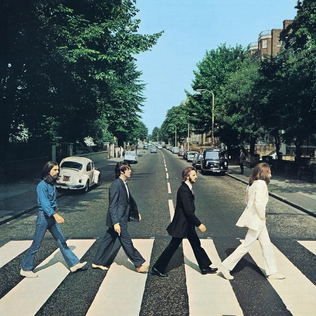
A final note about the album before we dive into the first song: The album cover is one of the most instantly recognizable images... ever. It features neither the name of the group nor the album title on the cover. 

The first song on Abbey Road is "Come Together". Probably one of the more lyrically cryptic songs in the Beatles repertoire, there are a couple of theories regarding the meaning. From Wikipedia:
It has been speculated that each verse refers cryptically to each of The Beatles (e.g. "he's one holy roller" allegedly refers to the spiritually inclined George Harrison; "he got monkey finger, he shoot Coca-Cola" to Ringo, the funny Beatle; "he got Ono sideboard, he one spinal cracker" to Lennon himself; and "got to be good-looking 'cause he's so hard to see" to Paul); however, it has also been suggested that the song has only a single "pariah-like protagonist" and Lennon was "painting another sardonic self-portrait".
I've heard this song many times, and when I read the first theory, a verse for each Beatle, it made perfect sense to me. I'm rather less fond of the second, that Lennon was writing of a single character (possibly himself), but before I started this post I did feel that the song was about an individual instead of several. Both theories are possible; I think it's up to the listener to decide which is more or less likely. (One thing I find somewhat eerie about this song is that John whispers "Shoot me" a few times throughout, which is almost unrecognizable due to Paul's distinctive bass riff and Ringo's drums.)

That's all for today! On to the next great song tomorrow. I do find it appropriate that the first song on the last Beatles album, when the guys had agreed to set aside their differences for one last hurrah, is called "Come Together."


~~~~~~~~~~~~~~~
Heard It Tally: 40
Songs Completed: 172